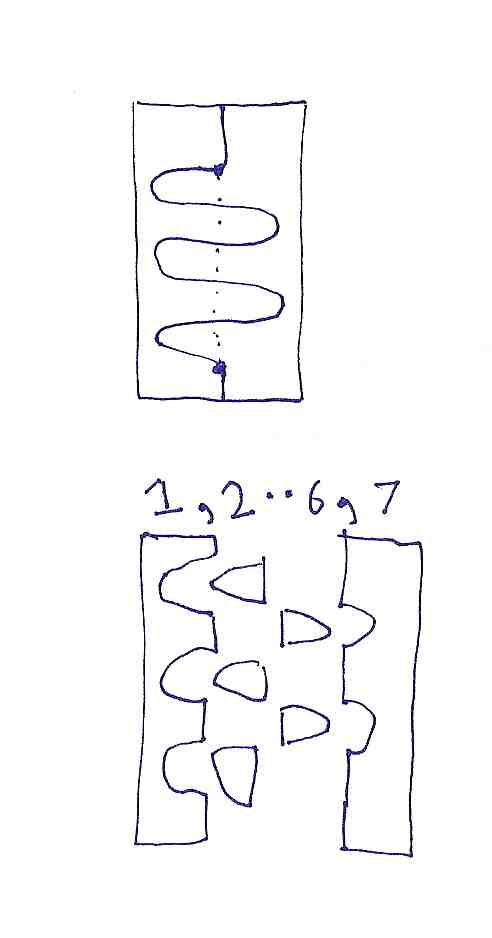
I really hate this problem. It is usually stated as I just gave it, with physical cuts to something like a gold or silver bar, and asks you to make two cuts and end up with seven equal value pieces. As you can see in the picture to the left is if the cuts t have to be straight then two cuts into seven pieces is totally doable. The only time consuming part is figuring out a function that cuts the object into the right sized pieces so that the sidepieces have the same volume as the central pieces, causing all the pieces to have a uniform value.
So what you are supposed to do with this problem is to make two cuts into pieces of size 1/7, 2/7, and 4/7th of your total. That lets you assemble any value from one to one seventh the total value, as long as you can swap back a previous payment.
So the first payment is 1/7th, the second you swap the 1/7th for the 2/7th payment, and then the third payment you give both the 1/7th and 2/7th payments. The progression gives values from 1/7th to 1 in steps of 1/7th of the total.
1,
2,
1+2,
4,
4+1,
4+2,
4+2+1,
My friend Konrad made a suggestion I really like. He pointed out that if you change the problem so that you only have three checks and need to make seven equal payments, I think it is clearer.