 .
.
Ok this is one of those problems that looks hard until you step back and break it into pieces. Then it is cake.
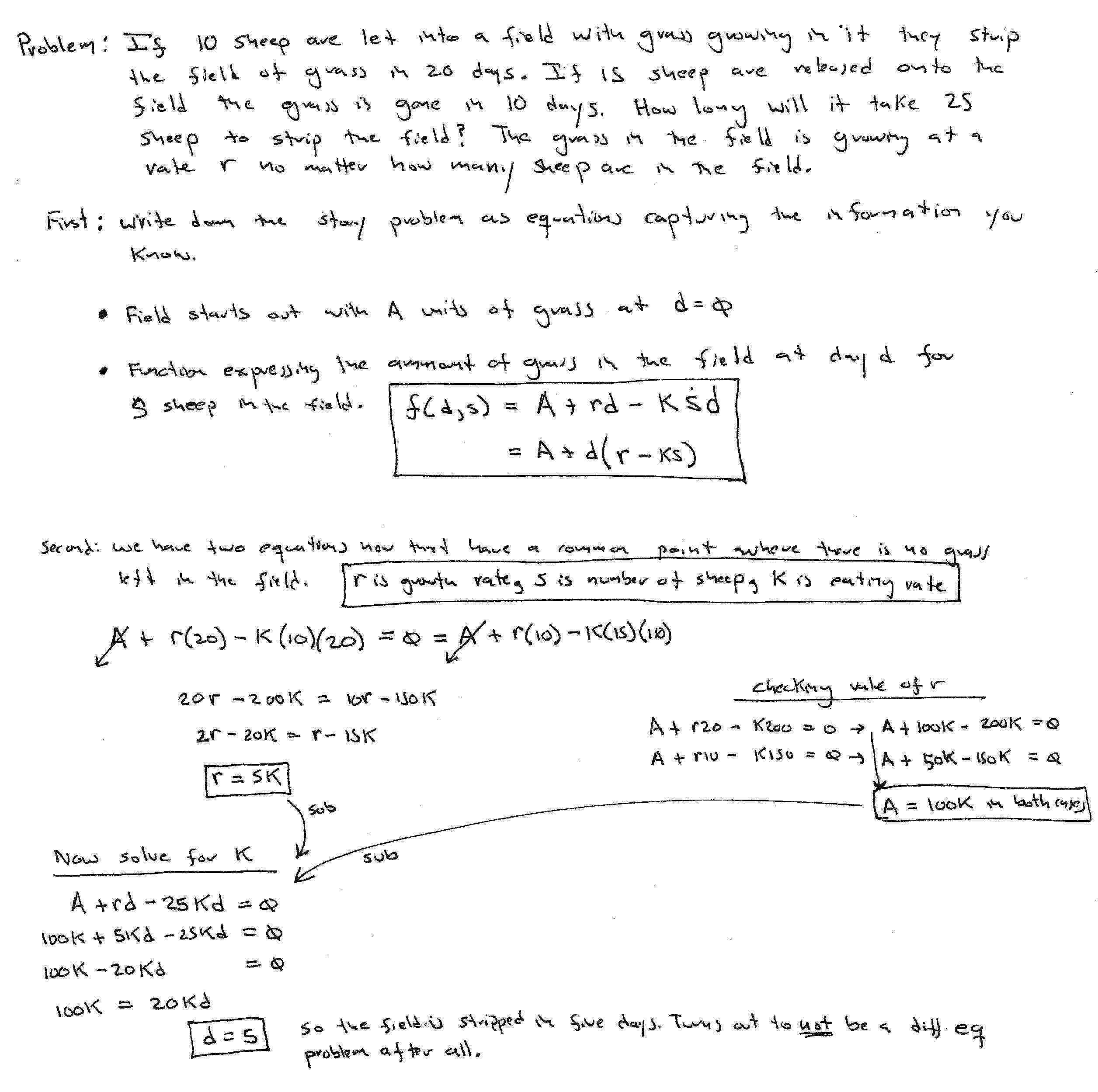
Like any complicated problem, first write down what you know, ideally, as equations. Writing out a story problem as equations capturing the information you know.
So writing down what we know about the problem observe: 1.Field starts out with A units of grass at day d= 0; 2.Grass grows at a rate of r per day not depended on s 3.Sheep eat at an unknown rate of k units per day
Now we write a function expressing the amount of grass in the field at day d for s sheep in the field.
f(d,s) = A + rd
So now we plug our numbers into the two equations for the
different days the field is stripped.
Day one: s=10, d=20
Day two: s=15, d=10
So the function has variables A,d,r,k, and s. We can plug in two different values of s and d for known value of a stripped field, 0. A is the same for both equations and can be canceled out at the point with two points where the equal has the value of 0, leaving variables r and k. So we can solve for the rate r in terms of k.
	A+d(r-ks) = 0 = A+d(r-ks)
  	d(r-ks)   =       d(r-ks)
	20(r-k10) =     10(r-k15)
	20r-200k  =     10r-150k
	2r-20k    =       r-15k
	r=5k
	Now we solve for A given r
	A+r20-k200=0
	A+(5k)20-k200=0
	A+100k-200k=0
	A=100k
	Now we can solve for K by plugging in the value of r and A
	A+rd-25Kd =0
	A+(5k)d-25kd=0
	100K-20kd=0
	100K=20kd
	5k=kd
	d=5
So we see the field is stripped in 5 days.